

IPPI Scientific Evenings - Competition and Culture: Chinese mothers' socialization goals and Arab immigrants in Hungary
2023. november 28. 18:00
Program
18:00 – 18:05 Welcome speech
Prof. dr. Győri János, ELTE PPK IPPI
18:05-18:30 How Chinese mothers socialize their children to competition
Prof. Márta Fülöp, DSc, HUN-REN Institute of Cognitive Neuroscience and Psychology, Research Centre of Natural Sciences
18:30–18:45 Q/A Discussion
5 minutes break
18:50–19:15 Arab immigrants acculturation in Hungary: the role of competitive and cooperative relations
Mariem Jebali, PhD student, ELTE PPK PDI / Prof. Márta Fülöp, DSc, HUN-REN Institute of Cognitive Neuroscience and Psychology, Research Centre of Natural Sciences
19:15–19:30 Q/A Discussion 19:30–19:35
Closing speech
Prof. dr. János Győri, ELTE PPK IPPI
Prof. Márta Fülöp, DSc How Chinese mothers socialize their children to competition (Presentation is available here.)
China has openly transformed into a highly competitive society, both in terms of the school system, business life, and the labor market, and this is changing the worldview, value system, and psychological characteristics of young people (H. Sun, 2006; Wu et al., 2007, Bai et al., 2008). Bian et al (2022) studied Chinese mothers’ parenting goals and found that they care more about their children’s academic competitiveness and personal well-being than their mothers’ generation.
The talk will focus on the parental goals Chinese mothers and fathers in different places of residence in China have and especially what kind of competitive attitude they attempt to socialize for their children being able to withstand the intensely competitive Chinese society. The talk will also focus on the ideas and socialization practices of adaptive coping with winning and losing as part of the competitive emotional and behavioral process. (NKFIH- OTKA-K 135963)
Prof. Márta Fülöp is scientific advisor and head of the Social and Cultural Research Group in the Institute of Cognitive Neuroscience and Psychology, HUN-REN Research Centre of Natural Sciences and a professor of social and cultural psychology in the Department of Social and Intercultural Psychology, Károli Gáspár University of the Reformed Church. She is secretary general of the International Association for Cross-Cultural Psychology and president of Children’s Identity and Citizenship: European Association.
Mariem Jebali / Márta Fülöp Arab immigrants acculturation in Hungary: the role of competitive and cooperative relations (Presentation is available here.)
There were approximately 12 000 immigrants of Arab ethnicity living in Hungary according to the latest Microcensus (2016). The number has been growing since significantly.
According to TÁRKI Social Research Institute in 2015 94% of the Hungarian respondents refused refugees of Arab ethnicity specifically (Vidra, 2018). Given the attitudes towards immigrants in Hungary it is an outstanding issue to understand how these immigrants, specifically immigrants of Arabic ethnicity are able to integrate into the Hungarian society, what kind of acculturation processes are characteristic to them. Although the first generations of Arabs arriving in Hungary took place in the 1970s and 1980s, the research on this ethnic group in different domains is scarce and close to non-existent.
Csepeli and Örkény (2021) studied Arab immigrants attachment to Hungary and found that it surpasses both their solidarity with the diaspora at large and their own ethnic group in Hungary. Besides, Arabs are most trusting toward fellow Arabs of their home country, have more faith in “the Hungarians” than in the Arabs living next door. The talk will focus on the acculturation orientation of Arabs from different nationalities moving to Hungary for different motives and their perception of the role of in-group and out-group competition in their acculturation. Participants were asked to associate to the word Hungary and to their own country and to the words competition and cooperation (AGA Technique, Szalay and Brent, 1967) followed by semi-structures interviews. The talk will highlight different acculturation strategies in relation to these competitive experiences.
Mariem Jebali, a Ph.D. student in Socialisation and Psychology of Social Processes Programme at the Faculty of Education and Psychology, ELTE. Graduated with an Master degree in Clinical and Health psychology from the same faculty. Currently researching the topic of “Acculturation of the Arab immigrants into the Hungarian society: the cooperation and competition strategies”. Currently working as a recruiter for GE Steam Power.
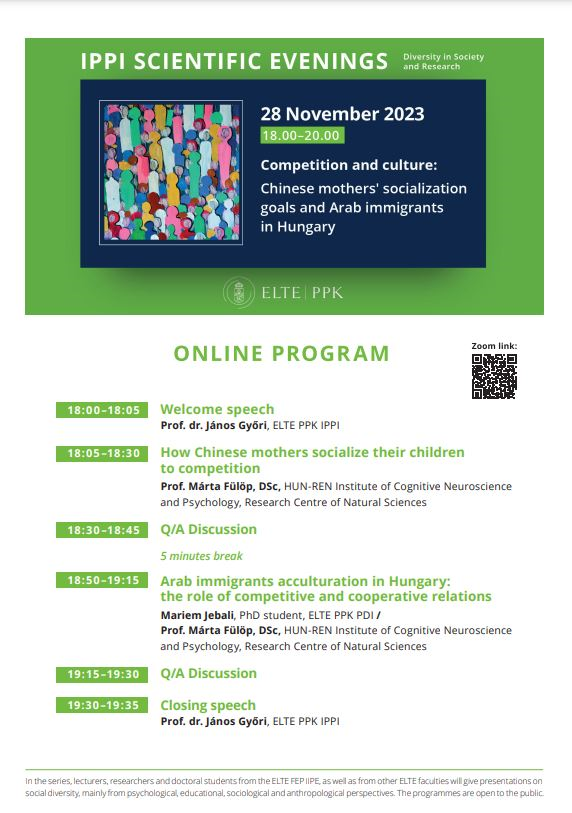
IIPE Rooftop Tea Party
Sucesfully held our informal event - IIPE Rooftop Tea Party with our students, PhD students and lecturers. We waited for everyone with tea, coffee and homemade cakes.
Positive feedbacks, vibes.
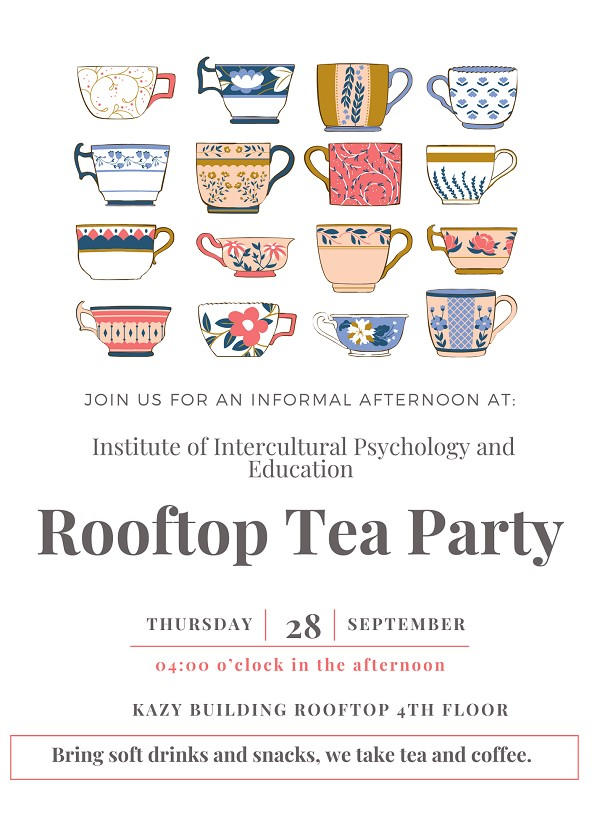

IIPE Scientific Evenings - 2nd of May, 2022 - Search for freedom, recognition and respect
1. Dilyara Seitova: Cosmopolitan orientation as egalitarian worldview // Click for the presentation.
2. Faranak Gholampour & Dr. Borbála Simonovits: Understanding migrant decision-making // Click for the presentation.
Programme:
18:00-18:05 Prof. dr. Győri János, ELTE FEP IIPE Welcome speech
18:05-18:35 Dilyara Seitova: Cosmopolitan Orientation as an expression of an Egalitarian Worldview: Implications For Sexism
PhD candidate, Doctoral School of Psychology, Faculty of Psychology and Education, ELTE
18:35-18:50 Q/A, discussion
5 minutes break
18:55-19:25 Faranak Gholampour*, Dr. Borbála Simonovits**Exploring the Migration Process of Iranian Asylum Seekers in Europe: A Case of Serbia and Bosnia and Herzegovina
* doctoral student, Doctoral School of Sociology, Faculty of Social Sciences, ELTE, ** assistant professor, ELTE FEP IIPE
19:25-19:40 Q/A, discussion
19:40-19:45 Prof. dr. Győri János, ELTE FEP IIPE Closing speech
IIPE Evenings - Public events at the Institute for Intercultural Psychology and Education
The purpose of the IIPE Evenings is to create a space for experts and an interested audience to consider and discuss issues related to intercultural topics understood in a wide context. The long-term objective is to build a network to find possible solutions to social problems by linking together experts’ knowledge. We invite external experts, including representatives of civil organisations, activists or researchers, to our thematic evenings. The primary target audience of our Evenings are the students and professors of our Faculty (especially of our Institute). However, anyone is welcome to attend.

“Mobilities, Transitions, Transformations – Intercultural Education at the Crossroads” Conference"
The conference explores the ways in which social, cultural and geographical mobilities, transitions and transformations are interpreted, constructed and re-constructed through the theory and practice of intercultural education, and aims to create an open forum for intercultural education theorists, practitioners and students to engage with current issues. The conference is organised on the basis of strands focusing on specific thematic areas which are accompanied by student panels coordinated by early career researchers. The conference is jointly organised by the International Association for Intercultural Education (IAIE) and the Institute of Intercultural Education (IIPE) at the Faculty of Education and Psychology of Eötvös Loránd University, Budapest, Hungary, in cooperation with the International Association for the Study of Cooperation in Education (IASCE) and the Tom Lantos Institute as supporting organisations.

Teachers’ intercultural views and their influence on classroom management
Project leader: Dr. János Győri
In line with the constructivist pedagogy and sociocognitive psychology cognition traditions of teachers’ cognition research, and considering the shift towards multiculturality in school, our research aims to study Hungarian school teachers’ interculturality-related attitudes and beliefs. Using quantitative and qualitative methods, with the participation of 300-350 teachers, we plan to reveal teachers’ beliefs and expectations concerning immigrant and other sociocultural minority (e.g. Roma) students. Teachers’ concepts about gifted students from these groups as well as teachers’ interpretations of differences between female and male students in these groups and in general are also to be examined. A smaller group of teachers will be selected on the basis of specific criteria to participate in a classroom observation study – a method of research that is not particularly widespread in Hungary. Its target is to show whether teachers’ interculturality-related beliefs are reflected, and if yes, how these beliefs are manifested in their classroom practices. We hypothesise that in the current situation, teachers’ thinking in Hungary is more strongly characterised by the monocultural concept, and much less by the realisation of sociocultural diversity, and as a consequence, the former will dominate their beliefs and classroom practices. We also expect that variability in teachers’ belief systems and classroom practices in some cases can be accounted for by teachers’ different levels of education, the school atmosphere or the fact that they have or do not have minority students. Download paper I. and paper II.

Identity at the crossroads of cultures
Project leader: Dr. habil. Lan Anh Nguyen Luu
Our study aims to investigate the development of European, national and ethno-cultural identities of the majority and ethnic minorities and immigrant adolescents in Hungary in a broader societal, intercultural and socialisational context. The main questions of our investigation include inquiries about how ethnic minorities and immigrants construct their ethno-cultural identities, how these identities relate to their national and European identities, how these groups perceive larger society, and in their view how the majority group supports, tolerates, or on the contrary, ignores or discriminates against them on the basis of their ethno-cultural identities. Majority adolescents are also asked about their identities and acculturation orientations. The research seeks to draw links between acculturation and age, success in school, quality of peer relationships and ethnic identity. Download Paper.
